The Barbershop Prophet: How Ulysses Davis Secretly Carved America's Soul While Nobody Was Watching
The Double Life of a Savannah Barber
Every morning for four decades, Ulysses Davis would unlock his barbershop on Montgomery Street in Savannah, Georgia, arrange his scissors and combs, and prepare to spend another day making people look presentable. But when the last customer left and the "Open" sign flipped to "Closed," Davis would retreat to a cramped back room where his real calling waited.
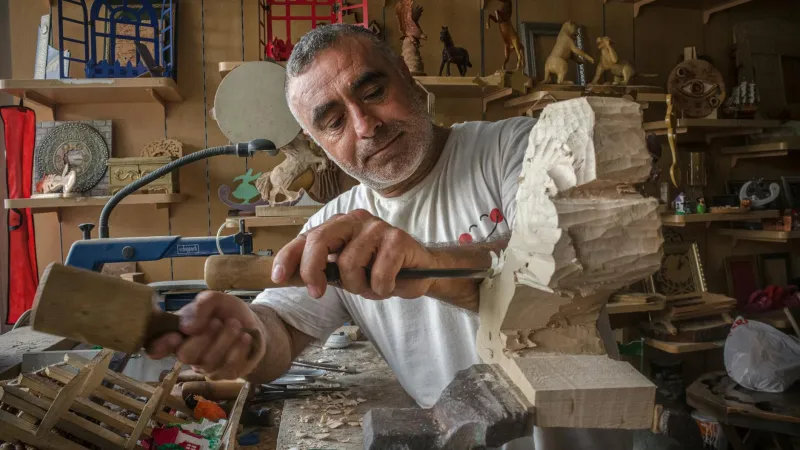
There, surrounded by wood shavings and half-finished sculptures, Davis would pick up his carving tools and continue a project that had consumed him since the 1960s: creating wooden busts of every American president, along with an entire universe of folk art figures that seemed to spring directly from his imagination.
Nobody knew. Not really. His customers might have glimpsed a carving or two, but they had no idea that their friendly neighborhood barber was quietly building one of the most remarkable bodies of self-taught American art of the 20th century.
Carving Presidents in the Shadows
Davis didn't set out to become an artist. Born in 1913, he learned barbering as a young man and seemed destined for a life of steady, unremarkable work. But something stirred in him when he picked up his first piece of wood. Maybe it was the same impulse that drove him to study faces all day—the curves of a cheekbone, the set of a jaw, the way character revealed itself in the smallest details.
He started with Abraham Lincoln. Then George Washington. Before long, he was working his way through every president, carving their likenesses from memory and whatever photographs he could find. Each sculpture took months to complete, and Davis demanded perfection from himself that no art school could have imposed.
The presidents weren't his only subjects. His workshop filled with carved figures of historical personalities, religious icons, and characters that seemed to emerge from the deepest wells of American folklore. A wooden Martin Luther King Jr. stood alongside carved representations of biblical figures. Folk heroes shared shelf space with Davis's own imaginative creations.
The Art World Discovers a Secret
For decades, this extraordinary body of work remained virtually unknown outside of Davis's immediate neighborhood. He wasn't trying to hide it, exactly—he simply had no connection to the art world and no particular desire to seek recognition. He carved because something inside him demanded it, the same way other people breathe or dream.
Then, in the 1980s, everything changed. Art historians and folk art collectors, always on the hunt for undiscovered talent, began hearing whispers about a barber in Savannah who carved remarkable sculptures. When they finally made their way to Montgomery Street and saw Davis's work, they couldn't believe what they'd found.
Here was an entirely self-taught artist who had been creating sophisticated, powerful sculptures for decades without any formal training or outside influence. His presidential busts captured not just physical likenesses but something deeper—the weight of office, the burden of leadership, the humanity behind the historical figures.
Recognition That Came Almost Too Late
By the time the art world discovered Ulysses Davis, he was already in his seventies. Museums began acquiring his work, and suddenly the barber who had labored in obscurity found himself celebrated as a master of American folk art. The Smithsonian acquired several of his pieces. Art critics wrote about his "intuitive understanding of form" and his "remarkable ability to capture character in wood."
Davis took the attention in stride. He had never carved for fame or money—he carved because he had to, because something in him demanded that he transform blocks of wood into living, breathing representations of the people and ideas that fascinated him.
The Legacy of Patient Creation
Davis died in 1990, but his story resonates far beyond the art world. In an age of instant gratification and social media validation, his life offers a different model of creative fulfillment. He spent forty years perfecting his craft in near-total obscurity, driven by nothing more than an inner calling and his own exacting standards.
His workshop, preserved much as he left it, tells the story of what's possible when someone commits completely to their craft without worrying about external validation. Every presidential bust, every folk figure, every carefully carved detail represents hours of patient work done for its own sake.
The Calling That Couldn't Be Ignored
Ulysses Davis never called himself an artist. He was a barber who carved wood, a working man who happened to have an extraordinary gift and the discipline to nurture it. His story reminds us that greatness often grows in the most unexpected places, tended by people who never set out to change the world but simply couldn't ignore the voice inside them that demanded they create.
In a culture obsessed with overnight success and viral fame, Davis offers a different path: the slow, steady accumulation of mastery, the quiet satisfaction of work done well, and the profound impact that can come from following an uncommon calling, even when nobody's watching.