The Chess Drum and the Kid Who Wasn't Supposed to Play
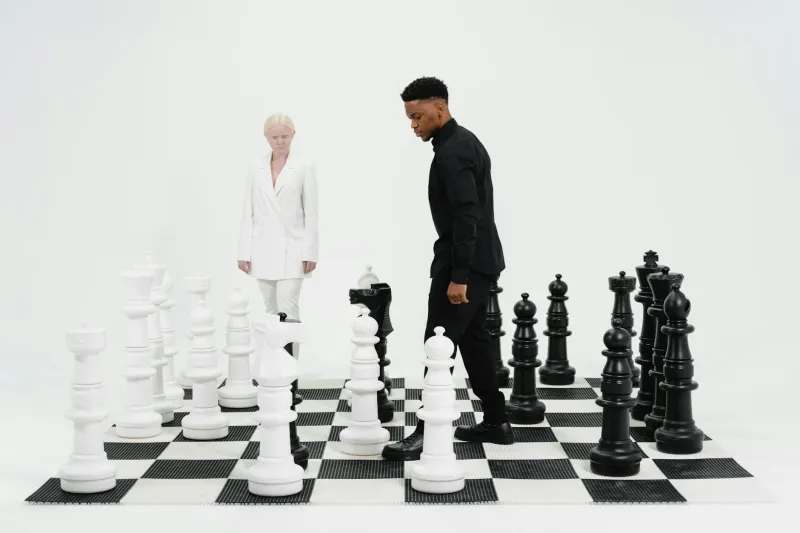
The Board Nobody Reserved for Him
There's a version of chess history that gets told a lot. It involves prodigies from Eastern Europe, private coaches, Ivy League clubs, and the kind of institutional support that turns raw talent into decorated careers. It's a real story. It's just not the only one.
Daaim Shabazz grew up in Chicago without access to any of that. No private tutors. No elite academies. What he had was a community center, a chessboard, and the kind of stubborn curiosity that doesn't ask for permission before it gets serious about something.
He learned the game the way most working-class kids learn anything worth knowing — by showing up, watching, losing a lot, and coming back anyway. Chess, for Shabazz, wasn't a status symbol or an academic credential. It was a language, and he intended to become fluent.
What the Game Didn't Show Him
As Shabazz got better, he started noticing something. The players who looked like him were largely invisible in the places where chess got covered, celebrated, and archived. Black players had been competing at high levels for generations — figures like Maurice Ashley, who in 1999 became the first African American chess grandmaster — but the mainstream chess press treated their stories as footnotes, if it acknowledged them at all.
That absence wasn't accidental. Elite intellectual spaces have a long habit of deciding, in advance, who the 'naturals' are. Chess had built its mythology around a particular kind of genius — one that, not coincidentally, tended to look a lot like the institutions funding and covering the game. Anyone who didn't fit the profile had to work twice as hard just to get half the recognition.
Shabazz saw all of this clearly. And instead of waiting for someone else to fix it, he did something characteristically direct: he built his own platform.
Building the Drum
In 1998, Shabazz launched The Chess Drum — a website dedicated to covering Black players and chess communities across the African diaspora. At the time, this was a genuinely radical act. The internet was still finding its footing as a publishing medium, and the idea that a working-class kid from Chicago could create a globally significant outlet for chess journalism wasn't something the establishment had planned for.
But that's exactly what happened.
The Chess Drum grew into the definitive resource for anyone wanting to understand chess as it was actually being played across Africa, the Caribbean, and Black communities throughout the United States. Shabazz traveled to tournaments on multiple continents. He interviewed players, documented tournaments, and wrote with the kind of depth and care that the mainstream chess press had never bothered to extend to this corner of the game.
He wasn't just filling a gap. He was reframing an entire conversation about who chess belongs to.
The Grandmaster Question
Shabazz himself earned a FIDE Master title — a significant achievement by any measure — but his influence on chess culture has always extended far beyond his own competitive record. He became a coach, a scholar of the game's history, and one of the most respected voices in international chess circles. Academic institutions and chess organizations that once would have overlooked someone with his background began seeking out his perspective.
There's something worth sitting with in that arc. The chess world didn't open its doors to Daaim Shabazz because it had a change of heart. It opened them — or rather, he pushed them open — because he built something too important to ignore. The Chess Drum forced a reckoning with a history that had been deliberately kept out of frame.
What 'Natural' Really Means
When we call someone a natural — in chess, in science, in any field that gets coded as elite — we're usually making a claim about inevitability. This person was always going to rise. The path was always going to open up for them.
What Shabazz's story exposes is how much of that narrative is constructed after the fact, and in whose favor. Plenty of people with his talent never got the visibility he eventually earned, not because they weren't exceptional, but because no one built a platform for them. No one decided their stories were worth telling.
He decided his were. And then he decided everyone else's were too.
The Chess Drum is, at its core, an act of documentation — a refusal to let an entire tradition disappear into the margins of a game that belongs to everyone who loves it. That's not a small thing. In a culture that still tends to treat certain kinds of achievement as inherently more legitimate than others, insisting that the full picture gets recorded is its own form of mastery.
Daaim Shabazz learned chess in a community center on the South Side of Chicago. He went on to change who gets to be seen at the board. The game is larger for it.