The Women Who Stitched the Stars: How a Factory Floor Full of Seamstresses Held the Space Race Together
Every photograph from the Apollo missions tells the same story: brave men, enormous rockets, the vast silence of space. The suits those men wore are right there in every frame — white, gleaming, impossibly complex — and nobody ever thinks to ask who made them.
The answer is a group of women in a factory in Dover, Delaware, who learned their trade sewing intimate apparel.
The Problem Nobody Had Solved
By the early 1960s, NASA had a rocket problem and a suit problem, and the suit problem was arguably harder. Sending a human being into space required wrapping that human being in a garment that could maintain internal pressure, withstand temperature swings from 250 degrees above zero to 250 below, protect against micrometeorite impacts, allow enough flexibility for an astronaut to actually move, and do all of this while weighing as little as possible.
No existing technology could do it. The aerospace companies that bid on the contract approached it as an engineering challenge — rigid structures, mechanical joints, materials science. They produced suits that were technically impressive and practically useless. You couldn't bend your knees. You couldn't grip a tool. You couldn't do the work that being on the moon required.
ILC Dover won the contract not because of their engineering credentials — they had fewer of those than their competitors — but because they understood something the engineers had missed. This wasn't an engineering problem. It was a sewing problem.
Women Who Knew Fabric
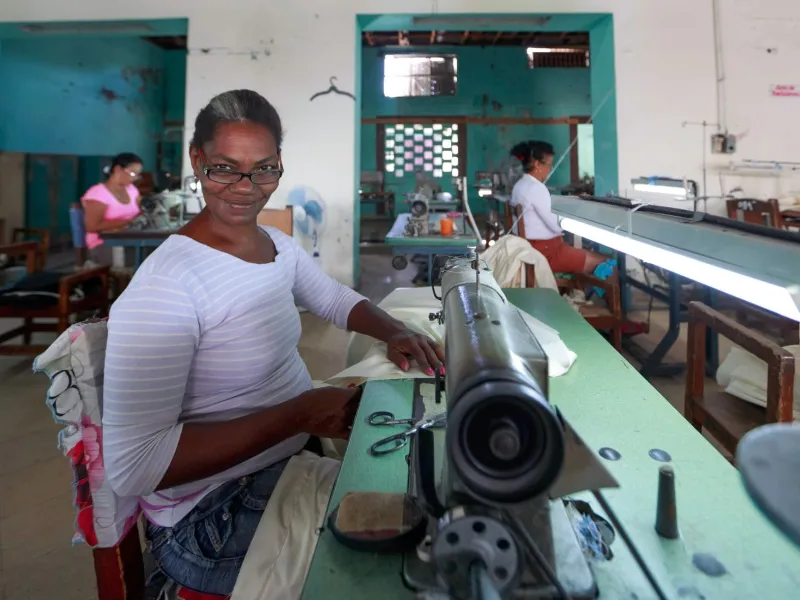
ILC Dover's workforce was built around women who had spent careers in the garment industry. Many of them had worked for Playtex, the intimate apparel company, which was ILC's parent organization. They understood, at a level that came from years of physical practice, how fabric moved under tension, where stress points accumulated, how a seam could be constructed to hold under repeated flexion without losing integrity.
Eleanor Foraker was one of them. She'd been sewing since she was a teenager, had worked her way up through the garment trade, and arrived at ILC Dover in the early 1960s as a senior seamstress. When the spacesuit contract came through, she and her colleagues were handed materials they'd never touched before — layers of neoprene, nylon, Dacron, and a Teflon-coated fabric called Beta cloth — and told to make something that had never been made.
They figured it out.
The Tolerance of a Surgeon, the Patience of a Saint
The suits that went to the moon were assembled from 21 separate layers of material, each one serving a specific protective function, all of them working together as a system. The outermost layers handled thermal regulation and micrometeorite protection. Inner layers maintained pressure. A network of restraint cables and carefully engineered seams allowed the whole assembly to flex without ballooning or collapsing.
Every stitch was done by hand. The tolerances were 1/64th of an inch — tighter than surgical work, tighter than watchmaking, tighter than almost any other manufacturing process in American industry at the time. A seam that wandered outside specification didn't get sent back for rework. It got thrown out entirely and started over.
Foraker and her colleagues worked under conditions of extraordinary pressure, both figurative and literal. NASA engineers were in the building constantly, reviewing progress, flagging concerns, changing specifications as mission requirements evolved. The women adapted. They developed new techniques, invented tools when existing ones didn't work, and built institutional knowledge that lived in their hands rather than in any manual.
There was no manual. They were writing it as they went.
The Gap Between Credit and Work
On July 20, 1969, Neil Armstrong stepped onto the lunar surface. The world watched. The astronauts were celebrated. The engineers at NASA and the aerospace contractors were celebrated. Mission Control was celebrated.
The women in Dover, Delaware, were not celebrated. Their names did not appear in newspaper headlines. They did not receive ticker-tape parades. Most of them went back to work the next morning.
This isn't unusual in the history of great achievements. The people whose names get attached to a moment are almost never the people whose hands built it. There's a long American tradition of celebrating the face of an accomplishment while the labor that made it possible recedes into anonymity. It happened with the space program the way it happened with the factories that built World War II, the way it happened with the domestic workers and seamstresses and assembly-line operators who underpinned nearly every celebrated era of American progress.
What makes the spacesuit story worth telling is how extreme the gap was. The suits were not incidental to the mission. They were the mission, in the most literal sense. Without them, the astronauts were dead the moment the hatch opened. Every minute Armstrong and Aldrin spent on the lunar surface was a minute those suits were performing exactly as Eleanor Foraker and her colleagues had built them to perform.
What an Ordinary Job Title Hides
Seamstress. It's a word that doesn't carry much weight in the popular imagination. It suggests something modest, domestic, peripheral. The women at ILC Dover held that title while performing work that was the opposite of all those things.
They were, in the most precise sense, engineers — not of circuits or trajectories, but of the interface between a human body and the void of space. The fact that their tools were needles and thread rather than slide rules and circuit boards didn't make the work less technical. It made it more demanding, because there was no margin for mechanical error and no machine precise enough to do what human hands could do.
Foraker worked at ILC Dover through the Apollo program and beyond. She trained other seamstresses. She held institutional knowledge that NASA eventually recognized as irreplaceable, because when the shuttle program came along and new suits were needed, the agency came back to the same factory, the same workforce, the same tradition of hand-stitched precision.
The Names We Should Know
The Apollo program had roughly 400,000 people working on it at its peak. Most of them are unknown. But within that vast anonymous workforce, the women who sewed the suits occupy a particular place — not because their contribution was larger than others, but because the distance between what they did and how they were recognized is so striking.
Eleanor Foraker and her colleagues held astronauts' lives in their hands, literally, with every stitch. They met a standard of precision that most industries never approach. They solved problems that the most credentialed engineers in the country couldn't crack.
They did it with needle and thread, in a factory in Delaware, and they did it without anyone outside that building knowing their names.
Now you do.