The Woman Behind the Flag Was More Interesting Than the Legend That Replaced Her
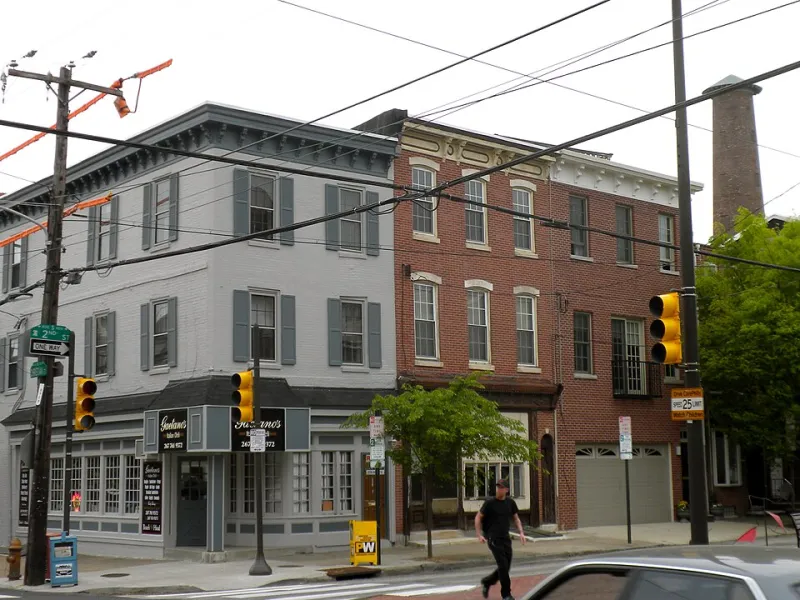
Photo: Smallbones, Public domain, via Wikimedia Commons
Somewhere in Philadelphia, there's a small brick house on Arch Street where tourists line up to stand in the room where Betsy Ross supposedly sewed the first American flag at George Washington's personal request. It's a pleasant story. It's also, in most of its specific details, almost certainly not true.
 Photo: George Washington, via images.firstpost.com
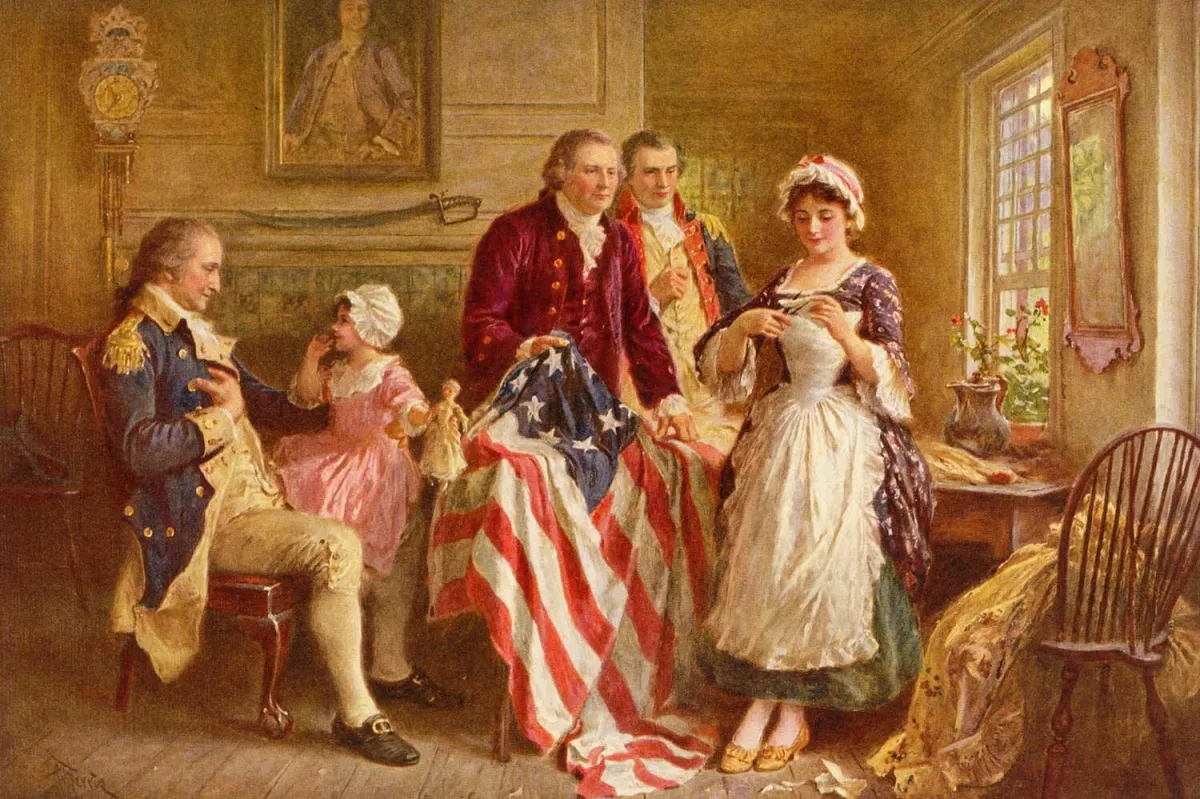 Photo: Betsy Ross, via images.squarespace-cdn.com
The version of Betsy Ross that lives in American memory — the serene seamstress quietly stitching a nation into being — was constructed in 1870 by her grandson William Canby, who presented an affidavit to the Historical Society of Pennsylvania claiming that his grandmother had told him the story of Washington's visit decades before her death. No corroborating documents exist. No contemporary accounts support it. Historians have been gently dismantling the myth for over a century.
But here's what tends to get lost in the debunking: the real Elizabeth Griscom Ross was genuinely extraordinary. She just wasn't extraordinary in the comfortable, symbolic way that made her useful to a nation building its origin stories. She was extraordinary in the difficult, unglamorous, quietly stubborn way that actual lives tend to produce.
The Woman Who Kept Working
Elizabeth Griscom was born in 1752 in Philadelphia, the eighth of seventeen children in a Quaker family. She learned upholstery — a skilled trade that encompassed sewing, fabric work, and the making and repairing of furniture, curtains, and household goods — and by her early twenties she was working in the shop of a man named John Webster.
She fell in love with a fellow apprentice named John Ross, eloped with him in 1773, and was promptly disowned by her Quaker congregation for marrying outside the faith. The couple set up their own upholstery shop. Then, in January 1776, John Ross died — possibly from an accidental gunpowder explosion while serving in the militia, though accounts vary. Elizabeth was twenty-four years old, widowed, running a small business, in the middle of a city that was about to become the epicenter of a revolution.
She kept the shop open.
This is the part of the story that deserves more attention than it typically gets. Philadelphia during the Revolutionary War was not a stable business environment. British troops occupied the city in 1777 and 1778. Supply chains were disrupted. Customers had more pressing concerns than upholstery. Many businesses failed. Ross did not fail. She found customers where she could, took in sewing contracts, and kept her enterprise alive through one of the most chaotic periods in American urban history.
Three Marriages, One Business
In 1777, Ross remarried — a sea captain named Joseph Ashburn, with whom she had two daughters. In 1782, Ashburn died in a British prison after being captured at sea. Ross was widowed a second time, now with children to support.
She married a third time in 1783, to a man named John Claypoole, who had actually been imprisoned alongside Ashburn and had carried news of his death back to Philadelphia. Claypoole survived, and the marriage lasted until his death in 1817. By then, Ross was in her mid-sixties and had been running some version of her upholstery business for nearly four decades.
She didn't stop there. Historical records suggest she continued working well into her seventies and possibly her eighties, eventually turning the business over to her daughters and nieces. She died in 1836 at the age of eighty-four.
In a trade dominated almost entirely by men, in an era when widowhood frequently meant financial collapse, across a career that spanned the founding of a country and stretched nearly to its sixtieth birthday, Elizabeth Ross built and sustained a livelihood. That's not a footnote. That's a life.
Why Myths Eat Real Women
So why does the flag story persist? Why does a tale with no documentary support continue to be taught in elementary schools and commemorated with a tourist destination in Philadelphia?
Part of the answer is that myths are easier to carry than complicated realities. A woman sewing a flag at Washington's request is a clean image — passive, supportive, decorative. It places a woman at the center of the founding narrative without asking the narrative to change at all. She's there, but she's not disruptive. She's stitching, not deciding.
The real Betsy Ross is more disruptive, because the real Betsy Ross was an economic actor in a world that preferred women not to be. She ran a business. She competed with men in a skilled trade. She survived the deaths of two husbands without being financially destroyed by either loss. She worked into old age not because she had to, but apparently because the work was hers and she intended to keep doing it.
That version of the story doesn't fit as neatly on a commemorative plate. It raises questions about inheritance, labor, gender, and economic survival that the flag story neatly sidesteps.
What Gets Lost in the Telling
There's a particular kind of historical erasure that doesn't look like erasure because it involves celebration rather than silence. Betsy Ross wasn't forgotten — she was amplified, dramatically, by her grandson's 1870 presentation and by the nationalist appetite for founding-era stories that followed. She became a symbol.
But the symbol replaced the person. The seamstress who sewed one flag for one famous moment replaced the businesswoman who spent sixty years building something durable in difficult conditions. The quiet helper replaced the stubborn survivor.
The real Elizabeth Griscom Ross didn't need a visit from George Washington to be worth remembering. She needed the same thing most working women of her era needed and rarely received: someone willing to look at the actual record and find it sufficient.
It was more than sufficient. It was remarkable. It just didn't come with a legend attached — until her grandson decided to invent one, and the country decided it preferred the invention.
That preference tells us something. Not about Betsy Ross, but about which kinds of women's lives we've historically been willing to call worth celebrating, and which kinds we've needed to dress up before we could see them clearly.