Forty Kids and a Punchline: The Accidental Birth of American Stand-Up
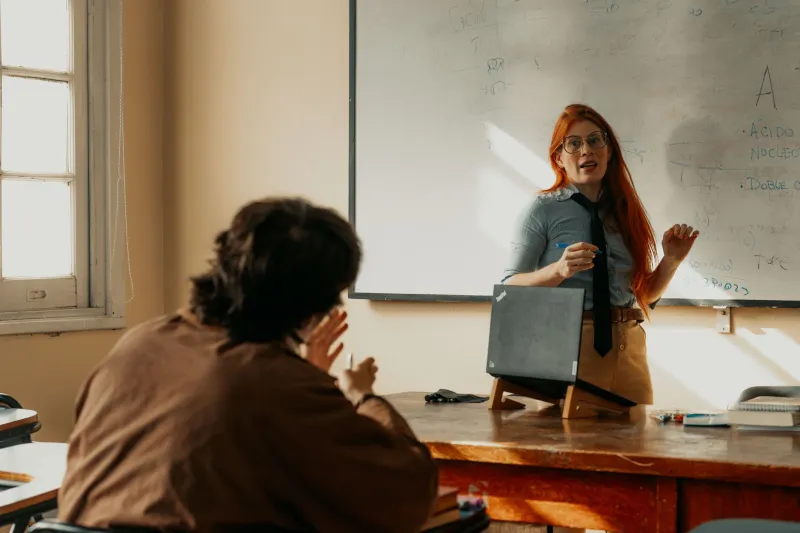
Most origin stories in American entertainment involve some version of ambition — the kid who dreamed of the spotlight, the performer who hustled from open mic to open mic, the comedian who knew from the age of seven that making people laugh was the only thing that made sense. Benjamin Rugg's story doesn't work that way. His origin story involves a substitute teacher's credential, a school district in central Ohio that was perpetually short-staffed, and the specific, low-grade panic of standing in front of forty bored teenagers with no lesson plan and no particular authority.
 Photo: Benjamin Rugg, via pulpitrock.com
What he discovered in that daily crucible — about attention, about timing, about the strange contract between a person speaking and a room full of people deciding whether to listen — would eventually become the foundation of an art form that didn't yet have a name.
The Job Nobody Wanted
In the 1920s, substitute teaching occupied roughly the same cultural territory as it does now: underpaid, underrespected, and requiring a very specific kind of nerve. You walked into someone else's classroom, inherited someone else's problems, and had about ninety seconds to establish enough credibility to make it through the day without chaos.
Rugg was not a natural authority figure. He was slight, soft-spoken, and had a tendency to get distracted by his own tangents in ways that made formal instruction something of a challenge. He'd studied literature at a small college in the Midwest, had vague ambitions about writing, and had taken the substitute work because it paid better than the alternatives and left his mornings free.
What he hadn't anticipated was that the classroom would become a laboratory.
Survival as Innovation
The first time Rugg truly lost a room — a seventh-grade class somewhere around 1923, by his own later account — he did something that wasn't in any teaching manual. He stopped trying to teach. He started talking instead. Not about the curriculum, not about anything in particular. Just talking, following the thread of whatever thought came next, watching faces to see what landed and what didn't.
A few kids laughed. Then a few more. The room, which had been drifting toward the particular low-grade anarchy that substitute teachers dread, pulled back together. Not because anyone was paying attention to a lesson. Because someone at the front of the room was doing something genuinely unexpected: being honest about the absurdity of the situation they were all in together.
Rugg filed that observation away. He started doing it deliberately.
Over the next several years, working schools across three counties, he developed what he later described as "the art of the necessary digression" — a practice of using personal observation, comic timing, and a carefully calibrated willingness to make himself the butt of the joke to hold a room together. He learned that self-deprecation worked better than authority. He learned that a well-placed pause could be more effective than a punchline. He learned that the moment you acknowledged what everyone in the room was already thinking, the dynamic shifted entirely.
He was, without knowing it, developing the grammar of stand-up comedy about two decades before anyone thought to give it that name.
From Classroom to Congregation Hall
The transition from classroom to something more like a stage happened gradually and without any grand design. A church social here. A community fundraiser there. Rugg was occasionally asked to "say a few words" at local events, and the few words had a way of expanding into something longer, looser, and considerably funnier than anyone had expected.
Word spread the way it does in small communities — slowly, then suddenly. People started requesting him specifically. Not as a speaker in any formal sense, but as someone who could make a room feel alive in a way that was hard to describe but immediately recognizable when you experienced it.
What he was doing was new enough that audiences didn't quite have a category for it. It wasn't a speech. It wasn't a performance in the theatrical sense. It was something more intimate and more spontaneous — a single person standing in front of a crowd and constructing, in real time, a shared experience out of nothing but observation and language.
The Grammar Nobody Wrote Down
Rugg never wrote a manifesto. He didn't think of himself as inventing anything. He was just doing what had worked in the classroom and discovering, somewhat to his own surprise, that it worked everywhere else too.
But the techniques he was developing by instinct — the callback, the setup-and-subversion, the strategic confession, the use of silence as punctuation — were the same techniques that would later be codified, taught, and argued about in comedy clubs from New York to Los Angeles. He arrived at them not through theory but through the most unforgiving feedback mechanism imaginable: a room full of people who had absolutely no obligation to pretend they were entertained.
 Photo: New York, via justinkelefas.com
Classrooms, it turns out, are brutal training grounds. There's no polite laughter in a seventh-grade classroom. There's no social pressure to smile at a joke that isn't working. If you lose the room, you lose it completely, and you have to find your way back in real time with everyone watching. Every comedian who has ever died on stage and clawed their way back has experienced some version of what Rugg experienced every day for years — except Rugg experienced it before he had any idea that what he was developing had value beyond getting through the afternoon.
What Necessity Built
The comedians who came after Rugg — the ones who built careers in vaudeville, in nightclubs, eventually on television — were working in a tradition that had been shaped, invisibly, by people like him. The idea that a single performer could hold a room with nothing but their voice and their perspective, that the audience's recognition of shared experience was itself a kind of punchline, that vulnerability was funnier than authority — these weren't obvious ideas. Someone had to figure them out.
Rugg figured them out in a drafty schoolroom in Ohio because he had no other option.
There's something almost counterintuitive about that. We tend to think of creative breakthroughs as the products of ambition and vision — someone who sees a possibility and pursues it. But some of the most durable innovations in any creative field come from the opposite direction: someone backed into a corner, running out of time, reaching for whatever works.
Benjamin Rugg wasn't trying to change American entertainment. He was trying to get through Tuesday. The fact that those two things turned out to be connected says something important about where real creativity tends to live — not in the spotlight, but in the scramble just before the spotlight comes on.