Eight Seconds at a Time: The Rodeo Performer Who Taught Corporate America How to Sell
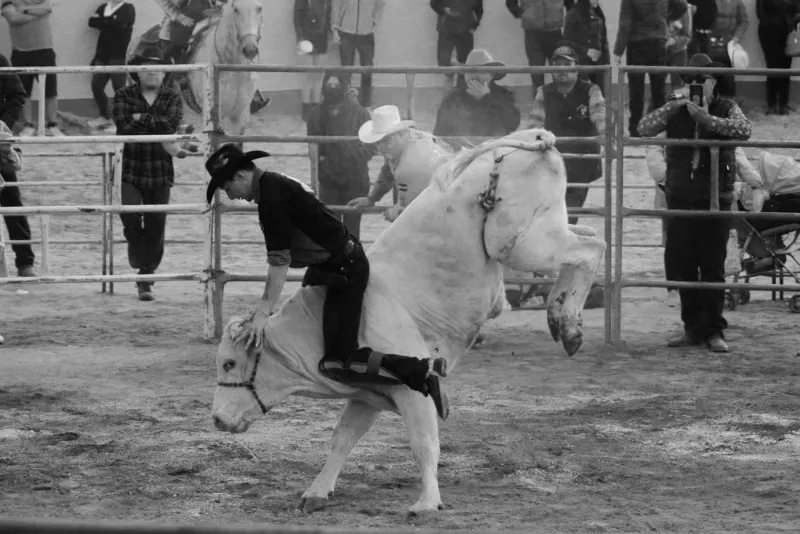
Before there were motivational keynotes in hotel ballrooms. Before there were laminated binders full of sales frameworks and leadership principles. Before the entire industry of corporate training existed at all, a man named Buck Rodgers was standing in front of a two-thousand-pound bull, buying eight seconds of survival with nothing but timing, instinct, and the ability to read a crowd.
It turns out those skills translate remarkably well to a conference room.
The Arena as Classroom
Rodgers grew up in the rural Midwest in the 1930s, in the kind of community where rodeos weren't entertainment — they were the calendar. County fairs, traveling circuits, weekend competitions at dusty fairgrounds across the plains. For a young man with more nerve than options, the rodeo offered something rare: a stage.
He started as a general hand and worked his way into the role that most people remember without ever really thinking about — the rodeo clown. It's a job that looks like comedy from the grandstands and feels like controlled chaos from inside the arena. When a bull rider hits the dirt, the clown runs toward the animal, not away from it. The job is to distract, redirect, and buy time for the fallen rider to get clear.
To do it well, you have to understand fear — your own, the crowd's, and crucially, the animal's. You have to read body language at a speed that outpaces conscious thought. You have to perform with precision under conditions specifically designed to make precision impossible. And you have to make it look easy, because if the crowd senses panic, the panic spreads.
Rodgers spent years getting good at all of it. He didn't know he was building a curriculum.
The Strangest Job Interview in IBM History
By the early 1950s, Rodgers was in his late twenties and the rodeo circuit was wearing on him. The injuries accumulated. The pay was irregular. He had a family to think about, and the arithmetic of arena life wasn't adding up.
A friend mentioned that IBM was hiring salespeople in the region. Rodgers had no background in technology, no college degree in business, and a resume that featured, as its primary credential, the ability to outrun a bull. He applied anyway.
The story goes that during his interview, when asked to describe his experience working with difficult clients, Rodgers talked about bulls. Not metaphorically — literally. He described reading an animal's weight shifts, anticipating the direction of a charge, and managing the emotional temperature of a crowd that was one bad moment away from panic. The interviewer, apparently, found this more compelling than expected.
Rodgers got the job.
What the Arena Taught the Boardroom
He turned out to be a natural. Not because selling IBM equipment in the 1950s resembled riding bulls in any technical sense, but because the underlying skills were nearly identical.
Selling, at its core, is performance under pressure. It requires reading a room — sensing when a client is engaged, when they're drifting, when they've already decided and just need someone to confirm the decision. It requires managing your own anxiety well enough that the person across the table never catches a whiff of it. And it requires telling a story that lands, not the story you prepared, but the story this particular audience needs to hear right now.
Rodgers was exceptional at all three. And as he moved up through IBM's sales organization, he began formalizing what he knew intuitively. He started running training sessions for new salespeople, and instead of dry product briefings, he used narrative. He'd walk recruits through high-pressure scenarios the way he'd once walked junior rodeo hands through the mechanics of a distraction — what to watch for, how to breathe, what to do when things went sideways.
The sessions were unlike anything IBM's training culture had produced before. They were alive. They were grounded in real pressure rather than theoretical frameworks. And they worked.
From Dusty Arenas to Glossy Binders
What Rodgers built at IBM didn't stay at IBM. His methods spread through the sales training world the way good ideas tend to — slowly, then all at once. The emphasis on storytelling over product specification. The attention to nonverbal communication. The insistence that training should simulate real pressure rather than describe it from a safe distance.
These ideas are so embedded in corporate training culture today that most people delivering them have no idea where they came from. The leadership seminar that opens with a trust-fall exercise, the sales workshop that runs role-play scenarios designed to make participants uncomfortable, the keynote speaker who builds tension before delivering a resolution — all of it has roots in the same insight Rodgers developed in the arena: people learn best when they're operating at the edge of their comfort zone, with real stakes attached.
The billion-dollar training industry that exists today — the consultants and coaches and facilitators and motivational speakers — owes more than it knows to a tradition of performance under genuine pressure. Not the simulated pressure of a role-play, but the kind where something actually bad happens if you get it wrong.
The Lesson That Outlasted the Lesson
What makes Rodgers' story stick isn't the unlikely career pivot, though that's entertaining enough. It's the idea that the most transferable skills are often the ones that look least transferable on paper.
Reading a crowd. Managing fear. Performing when you'd rather run. These aren't rodeo skills or sales skills or leadership skills. They're human skills — the kind that show up everywhere once you learn to see them.
Buck Rodgers learned them in an arena, in front of a crowd that came to watch and stayed to be amazed. He carried them into a world that didn't know it needed them yet.
Turns out the best corporate trainer in American history was never in a corporation at all. He was in the dirt, eight seconds at a time, learning things no classroom had ever thought to teach.