Ink-Stained Guardians: The Factory Workers Who Secretly Saved a Language
The Last Shift at the Yiddish Press
By 1950, the golden age of Yiddish journalism in America was clearly ending. Circulation numbers for once-mighty newspapers like the Forverts (Jewish Daily Forward) were dropping as second-generation immigrants chose English over their parents' language. Advertisers were pulling out, and editorial staffs were shrinking.
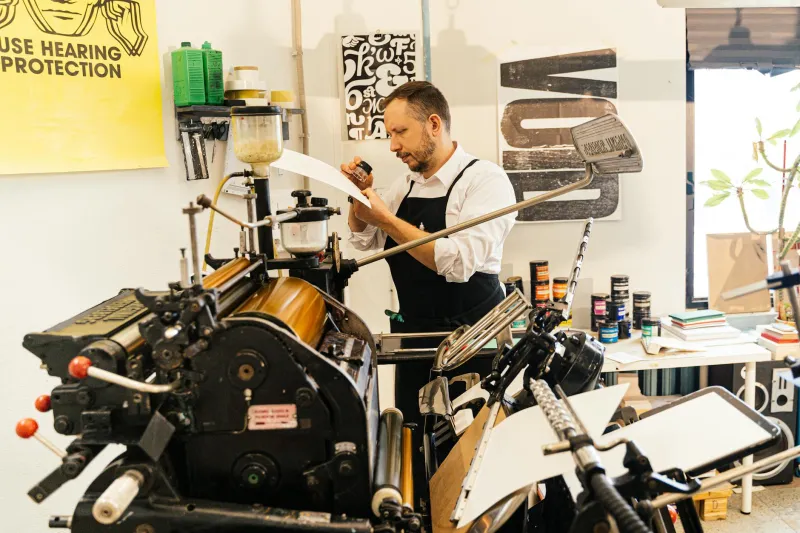
But in the basement pressrooms of New York, Chicago, and Philadelphia, a different story was unfolding. Long after the publishers had given up hope and the star columnists had moved on to English-language publications, the typesetters kept showing up for work.
These were men who had learned their trade setting type for Yiddish publications when the immigrant press was booming. Most had arrived in America with no formal education, having worked as peddlers, factory hands, or small shopkeepers in the old country. Typography became their skilled trade, their pathway into America's middle class.
Now, as that world disappeared around them, they found themselves in an unexpected position: they were the last people in America who could reliably set Yiddish type.
The Accidental Archivists
What the typesetters didn't realize was that their daily work had made them custodians of something extraordinary. Every poem, every serialized novel, every political editorial, every advertisement they set in type was creating a permanent record of Jewish-American life in the twentieth century.
Unlike handwritten documents that might be lost or damaged, printed materials were designed to last. The typesetters' careful attention to detail—getting every diacritical mark right, ensuring consistent spacing, maintaining the visual integrity that made Yiddish readable—meant they were creating an archive that would survive long after the newspapers themselves stopped publishing.
Men like Mordechai Strigler, who had peddled buttons on the Lower East Side before learning typography, found themselves setting type for some of the most important Yiddish writers of the era. Isaac Bashevis Singer's early stories, Sholem Asch's novels, and countless works by writers whose names are now forgotten—all passed through the hands of typesetters who often understood the literary significance of what they were preserving better than the business executives making decisions about the industry's future.
 Photo: Lower East Side, via as2.ftcdn.net
 Photo: Isaac Bashevis Singer, via bmw.scene7.com
More Than Just Mechanics
The relationship between Yiddish typesetters and the material they worked with was fundamentally different from their English-language counterparts. These men weren't just mechanically reproducing text—they were often the final editors, catching errors that writers and proofreaders had missed.
Many typesetters had been avid readers before they became craftsmen. They understood the nuances of Yiddish grammar, the regional dialects represented in different writers' work, and the cultural references that gave meaning to seemingly simple sentences.
When a writer's handwriting was unclear or a manuscript contained obvious errors, the typesetters would make corrections based on their deep familiarity with the language and its literary traditions. They became collaborative partners in the creative process, ensuring that the printed version of a text was often cleaner and more accurate than what the author had originally submitted.
The Economics of Cultural Preservation
As Yiddish newspapers struggled financially, publishers faced a cruel irony: they needed their most skilled typesetters precisely when they could least afford to pay them well. Setting Yiddish type required specialized knowledge that couldn't be easily replaced, but the shrinking market meant there was no economic incentive to train new workers.
Many typesetters began working for dramatically reduced wages, understanding that their paychecks were subsidizing something larger than their individual employment. They were keeping alive the infrastructure that allowed Yiddish literature and journalism to continue existing in America.
Some supplemented their income by taking on side projects—setting type for small literary magazines, religious publications, or community newsletters that paid almost nothing but kept the language visible in American Jewish life.
The Hidden Network
What emerged during this period was an informal network of typesetters who moved between different Yiddish publications, sharing knowledge and ensuring that important work continued to find its way into print. When one newspaper folded, its typesetters would migrate to other publications, carrying their expertise and often their personal collections of type specimens and reference materials.
This network operated below the radar of the mainstream publishing industry. While English-language newspapers were consolidating and modernizing, the Yiddish press remained dependent on craft knowledge that existed primarily in the hands and memories of aging immigrants.
The typesetters developed their own informal training programs, passing along not just technical skills but cultural knowledge about how different kinds of Yiddish texts should be presented visually. They maintained standards of craftsmanship that reflected their understanding of Yiddish as a literary language deserving the same typographical respect as English or German.
The Archive They Built Without Knowing
Today, scholars working to digitize and preserve Yiddish literature are discovering the extraordinary scope of what these typesetters preserved. University libraries and research institutions hold millions of pages of Yiddish text that exist only because anonymous craftsmen continued setting type long after it made economic sense.
The typesetters' commitment to accuracy and consistency means that modern scholars can rely on printed Yiddish texts as authoritative versions of works that might otherwise have been lost. Their professional standards created a textual record that captures not just the words of Yiddish writers, but the visual culture of how those words were meant to be read.
Researchers are now using computational analysis to study patterns in Yiddish literature that are only visible because of the systematic preservation work that typesetters performed without thinking of themselves as archivists.
The Craft That Became Cultural Rescue
The story of America's Yiddish typesetters reveals something profound about how cultural preservation actually happens. It's rarely the result of grand institutional planning or deliberate preservation efforts. Instead, it emerges from the daily work of people who understand that their craft serves something larger than their immediate economic interests.
These men had immigrated to America seeking better opportunities, learned skilled trades, and found themselves accidentally positioned as the guardians of a literary tradition. Their dedication to professional excellence in a dying industry created an archive that scholars are only now beginning to fully appreciate.
When the last Yiddish newspapers finally stopped publishing, they left behind a textual legacy that exists primarily because typesetters understood that their work meant something beyond the weekly paycheck. They had kept the presses running not just for themselves, but for a language and culture they knew deserved to survive.
In the end, the factory workers and former peddlers who became typesetters had accomplished something that more famous figures in Jewish-American cultural life had failed to achieve: they had built a bridge between the Old World and the New that could carry an entire literary tradition safely into the future.