The Man Who Couldn't Hear the Music — And Heard It Better Than Anyone
Somewhere in the orthodoxy of the music industry, there exists an unspoken assumption: you have to hear sound to understand it. Producers have ears. Engineers have ears. The whole enterprise of recorded music — the EQ curves, the reverb tails, the careful placement of a vocal in a mix — is built on the premise that human hearing is the final arbiter of what works.
Evelyn Glennie has spent her entire career proving that assumption incomplete.
She is, by most measures, the world's most accomplished solo percussionist. She has recorded with orchestras, collaborated with everyone from Björk to Bobby McFerrin, performed at the closing ceremony of the London Olympics, and earned more than a hundred international awards. She has also been profoundly deaf since the age of twelve.
The story of how she got there — and what her path reveals about the nature of sound itself — is one of the most quietly radical in modern music.
A Farmhouse in Aberdeenshire
Glennie grew up on a farm in rural Scotland, the daughter of an accordion player. Music was in the household air long before she could name it. She started piano lessons young, then gravitated toward percussion with the kind of instinctive pull that, in retrospect, makes perfect sense.
But by the time she was eight, something was changing. A progressive nerve condition was steadily eroding her hearing. By twelve, it was almost entirely gone.
The conventional response to this news — from teachers, from well-meaning adults, from an educational system not built for exceptions — was to redirect her. There were other paths. More practical ones. A deaf child pursuing a career as a professional musician was, the consensus seemed to be, a category error.
Glennie disagreed. And she had a reason that went deeper than stubbornness.
Feeling the Frequency
Here is the thing about sound that most hearing people never have to consciously learn: it is not only an auditory experience. Sound is vibration. It moves through floors, through walls, through the bones of your body. A bass note at a concert isn't just something you hear — it's something you feel in your sternum, your jaw, the soles of your feet.
For most people, that physical dimension of sound is background noise to the experience of hearing. For Glennie, it became the foreground.
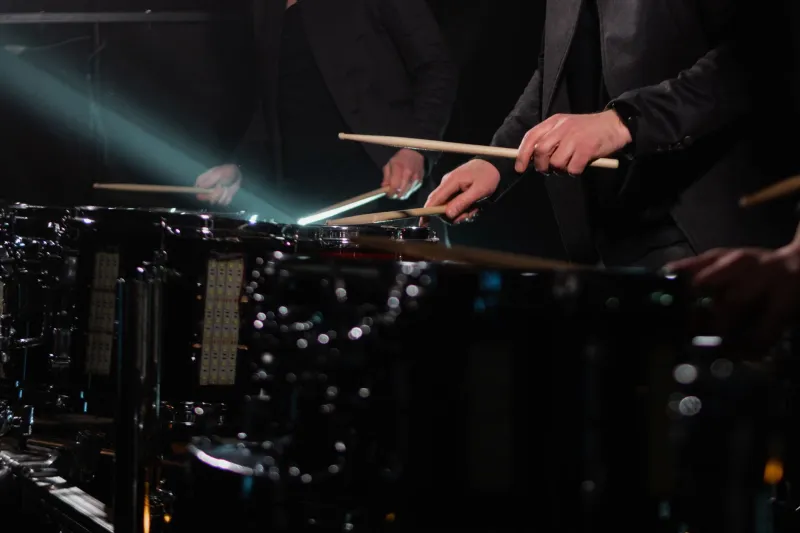
She learned to play barefoot, feeling the vibrations of her instruments travel up through the floor. She developed an understanding of how different parts of the body register different frequencies — how a high-pitched note from a snare drum lands differently in the hands than a deep resonance from a bass drum felt in the chest. She wasn't approximating the experience of hearing. She was experiencing sound through a different set of senses, and those senses turned out to be extraordinarily precise.
When she auditioned for the Royal Academy of Music in London, the institution initially hesitated. Her hearing loss was, they felt, a practical obstacle. One faculty member reportedly argued strongly for her admission anyway, insisting that what she demonstrated in her audition was not a workaround for deafness but something genuinely rare: an understanding of percussion that went beyond technique into something closer to physics.
She was admitted. She graduated with honors.
The Engineer in the Room Nobody Expected
What Glennie brought to concert halls and recording studios wasn't just technical mastery — it was a fundamentally different framework for thinking about sound design.
In sessions, she would describe the spatial quality of a sound, the way a note occupied physical space rather than just frequency range. She talked about texture in ways that forced producers and engineers to reconsider their vocabularies. Her collaborators — many of them with decades of experience in professional audio — described working with her as unexpectedly clarifying.
The hearing professionals in those rooms had spent careers training their ears. Glennie had spent hers training everything else. And in the gap between those two approaches, something genuinely new emerged.
She has spoken publicly about the tendency to treat deafness as a deficiency in a musical context — as something to be managed or worked around. Her argument, made quietly but persistently over decades, is that this framing gets it backwards. The absence of conventional hearing didn't limit her relationship with sound. It deepened it in directions that conventional hearing might have actually obscured.
A TED Talk and a Shift in Thinking
In 2003, Glennie delivered a TED Talk that has since been viewed millions of times. The talk, titled How to Truly Listen, doesn't spend much time on biography or inspiration. Instead, it makes a philosophical argument: that listening is a skill most people never fully develop because they outsource it entirely to their ears.
She performed during the talk, barefoot, and invited the audience to feel the music rather than simply hear it. It was, for many viewers, the first time they'd considered that those were different things.
The talk landed in music schools, in audio engineering programs, in spaces where people who work with sound professionally began asking themselves whether they'd been listening — truly listening — at all.
What Outsiders See
Glennie's story sits in a long tradition of people whose distance from a field's assumptions gave them a clearer view of its possibilities. She couldn't hear music the way the industry expected her to, so she had to understand it from first principles. That forced understanding turned out to be more complete, not less.
It's a pattern that shows up across disciplines: the outsider who, denied the usual tools, builds better ones. The person who can't take the conventional path and so discovers that the unconventional one leads somewhere more interesting.
Evelyn Glennie didn't overcome deafness to make music. She used it. And in doing so, she heard things the rest of the room had been missing all along.