The Oilcan Genius: How a Denied Engineer Lubricated the Entire Industrial Age
There's a version of Elijah McCoy's story that gets told as a tidy origin myth — the phrase "the real McCoy," the 57 patents, the escaped slaves who became the parents of an industrial genius. It's a satisfying arc. But the part that tends to get glossed over is the part that actually matters: the years he spent doing work he was never supposed to be doing, in a country that had already decided what kind of work he was allowed to do.
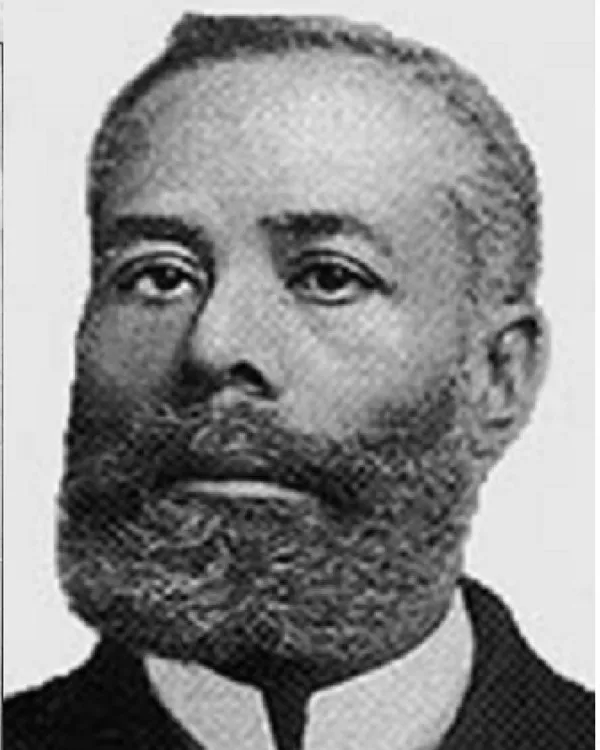 Photo: Elijah McCoy, via www.nps.gov
That gap between what McCoy was capable of and what America would allow is where his real story lives.
Born Running
Elijah McCoy came into the world in 1844 in Colchester, Ontario — not because his parents chose Canada, but because they had no choice. George and Mildred McCoy had escaped slavery in Kentucky via the Underground Railroad, crossing into a country that would actually let them exist as free people. Elijah was one of twelve children, born into a family that had already survived the unsurvivable.
George McCoy worked hard enough to save money, and when Elijah showed a gift for mechanical thinking, his parents sent him to Edinburgh, Scotland, for a formal engineering apprenticeship. He spent years there, training properly, earning his credentials, learning the language of pistons and pressure and precision. He came back to the United States in the 1860s a fully qualified mechanical engineer.
 Photo: Edinburgh, Scotland, via i.pinimg.com
And then America said: no.
Not in those exact words, of course. It never is. But the railroad companies that were hiring engineers in post-Civil War Michigan were not hiring Black engineers, no matter what their credentials said. The best work available to McCoy was a job as a fireman and oiler on the Michigan Central Railroad — meaning he shoveled coal into locomotive fireboxes and walked along the tracks lubricating the moving parts of the engine by hand.
He took the job. And then he started paying very close attention.
The Problem Nobody Had Solved
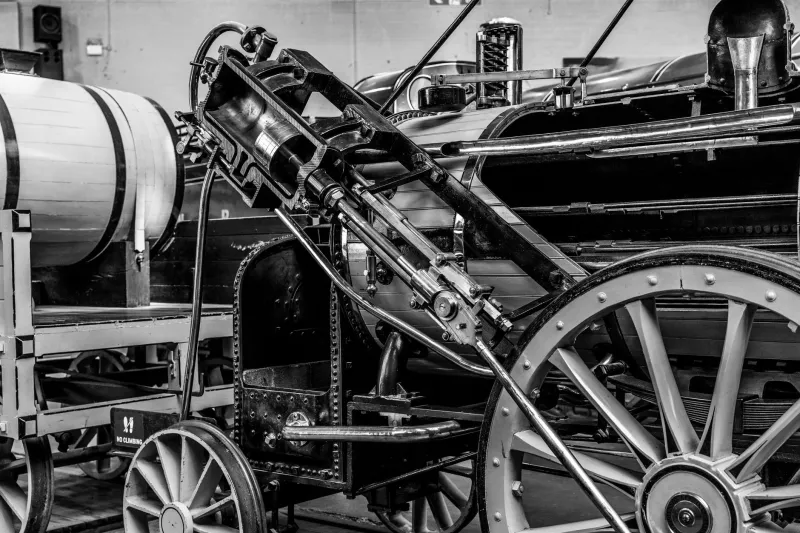
In the 1860s and 1870s, steam engines had a fundamental and expensive problem: they needed constant manual lubrication. Every moving metal part had to be oiled regularly, which meant stopping the machine, sending a worker in to apply lubricant by hand, and then starting everything back up again. It was slow, dangerous, and relentlessly inefficient. For railroads running on tight schedules across hundreds of miles, it was a genuine operational crisis.
McCoy understood the problem intimately because he was the person solving it by hand, every single day. He also understood something the engineers drafting plans in warm offices didn't: the solution wasn't more workers with more oilcans. The solution was building the lubrication into the machine itself.
In 1872, working out of a makeshift home workshop, McCoy patented his automatic lubricating cup — a small device that used steam pressure to deliver a steady, regulated flow of oil to an engine's moving parts while it was still running. No stopping. No manual application. No dangerous crawling around live machinery. Just continuous, self-regulating lubrication built directly into the mechanical system.
It was elegant. It was simple. And it worked better than anything that had come before it.
When Imitation Is Not Flattery
The railroad industry took notice fast. McCoy's lubricating cup spread across the industry, then into other sectors — mining equipment, factory machinery, steamships. Competitors, sensing money, rushed to produce cheaper versions. Some were functional. Many were not.
Engineers and purchasing managers who'd worked with McCoy's original device began to develop a habit: when ordering lubrication equipment, they'd specify that they wanted the genuine article, not the knockoffs flooding the market. They wanted, as the phrase went, the real McCoy.
The origin of that specific idiom is debated by etymologists, and McCoy himself isn't the only candidate for the source. But the fact that his name became synonymous with authenticated quality — in an era when his race was supposed to define his ceiling — carries a weight that no dictionary entry can fully capture.
He didn't stop at one patent. He kept inventing. Over the following decades, McCoy accumulated 57 patents in total, covering improvements to lubrication systems, a lawn sprinkler, an ironing board, and various other mechanical devices. He founded the Elijah McCoy Manufacturing Company in Detroit in 1920.
What the Ceiling Was Made Of
It would be easy to frame McCoy's story as a triumph-over-adversity narrative with a clean ending. But the cleaner truth is more uncomfortable. McCoy was denied the work he trained for because of his race, full stop. The invention that made him famous only existed because he was forced into manual labor. He didn't transcend the system — he was compelled by it, and he responded with extraordinary ingenuity despite it.
The United States lost decades of potential contributions from McCoy the engineer before it accidentally discovered McCoy the inventor. How many others never got even that accidental opening?
What McCoy's life actually demonstrates isn't that the system works for people who work hard enough. It's that some people are so relentlessly capable that they find a way to matter even inside systems designed to stop them. That's not the same thing as a success story. It's something rarer and more complicated — a man who refused to let a country's failure of imagination become his own.
He died in 1929, in his mid-eighties, in an era that was just beginning to reckon with what it had wasted. The machines he helped build were still running. His patents were still in use. And somewhere in American factories and rail yards, the phrase his work had inspired was still being spoken by engineers who had no idea where it came from — or what it had cost.