Pages Behind Bars: How a Teenager's Prison Sentence Became America's Most Unlikely Legal Education
The Book That Saved a Life
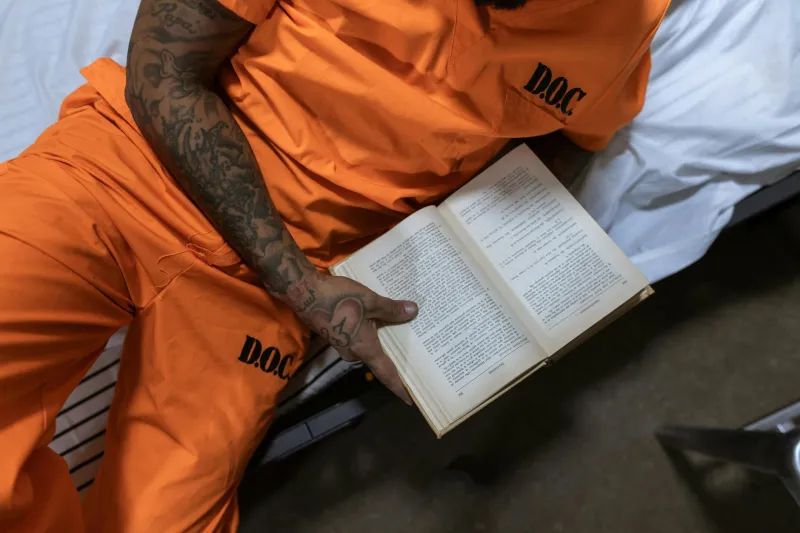
Reginald Dwayne Betts was three years into a nine-year sentence at Southampton Correctional Facility when he found a book someone had thrown on the floor of the prison's law library. "The Black Poets," edited by Dudley Randall, was dog-eared and water-damaged, the kind of discarded paperback that usually ended up in the trash.
 Photo: Southampton Correctional Facility, via www.napredaj.eu
Betts almost stepped over it. At nineteen, he'd already spent more time behind bars than in any classroom since middle school. Reading wasn't part of his identity — survival was. But something about the abandoned book caught his attention, maybe because it looked as forgotten and worthless as he felt.
That moment of curiosity would transform not just Betts's life, but reshape how America thinks about juvenile justice, prison reform, and the power of second chances.
The Path to Prison
Betts's journey to Southampton began with a decision that took thirty seconds and destroyed two lives. In 1996, at sixteen, he and a friend carjacked a man in Suitland, Maryland. Nobody was physically hurt, but the psychological trauma was real, and Betts knew it. Even as a teenager, he understood that his thirty seconds of poor judgment had caused genuine harm.
The adult court that tried him as an adult wasn't interested in his understanding or remorse. The judge saw a young Black man who'd committed a serious crime and sentenced him accordingly: nine years in adult prison, to be served alongside hardened criminals twice his age.
Betts arrived at Southampton angry, scared, and convinced his life was effectively over. In 1990s America, a young man with a violent felony conviction had few prospects beyond more prison time. The statistics were brutally clear: most people who entered the system at his age never really left it.
Discovering Words
The poetry collection Betts found that day contained work by Gwendolyn Brooks, Langston Hughes, and Claude McKay — writers who'd transformed pain into art, injustice into insight. For the first time, Betts encountered language that matched his experience: the rage, the complexity, the refusal to be reduced to simple categories of good and evil.
He started writing his own poems, initially just copying the styles he admired. Prison gave him something most aspiring writers lack: uninterrupted time to practice. While other inmates watched television or worked out, Betts filled notebook after notebook with verses about loss, regret, and the strange intimacy of life behind bars.
Writing became more than therapy — it became education. To understand the poems he loved, Betts had to learn about history, politics, and literary tradition. He requested books on everything from the Harlem Renaissance to legal theory, transforming his cell into an improvised graduate seminar.
The Accidental Scholar
Prison libraries aren't known for their academic resources, but Betts made the most of what was available. He read everything: legal textbooks abandoned by previous inmates, philosophy books donated by churches, even outdated encyclopedias. When he encountered concepts he didn't understand, he wrote letters to professors at nearby universities, asking for clarification and book recommendations.
Some professors ignored his letters. Others were intrigued by the thoughtful questions coming from a maximum-security prison. A few began corresponding regularly, recommending readings and discussing complex ideas about justice, literature, and social change.
Through these exchanges, Betts discovered he had an analytical mind capable of grappling with sophisticated ideas. More importantly, he realized that his experience — as a young Black man who'd committed a serious crime and was living with the consequences — gave him insights that many scholars lacked.
Freedom and New Challenges
Betts was released in 2005 after serving eight years. At twenty-four, he faced the challenge that confronts every formerly incarcerated person: how to build a legitimate life with a criminal record. Most employers wouldn't hire him. Most colleges wouldn't admit him. The conventional wisdom said he should be grateful for any minimum-wage job that would overlook his past.
Instead, Betts enrolled at Prince George's Community College, then transferred to the University of Maryland. His professors were initially skeptical — what could a former carjacker contribute to discussions of literature and law? But Betts's writing and analysis quickly proved his intellectual seriousness.
His poems, refined through years of prison practice, began appearing in respected literary journals. His essays about criminal justice, informed by lived experience and scholarly research, challenged both conservative and liberal assumptions about crime and punishment.
The Yale Years
In 2010, Yale Law School did something almost unprecedented: they admitted a former felon with an armed robbery conviction. The decision reflected growing recognition that traditional metrics of academic achievement might not capture all forms of valuable knowledge and perspective.
Betts thrived at Yale, but not without struggle. Many classmates had never met anyone who'd been to prison, much less someone who'd served hard time for a violent crime. Some professors seemed uncomfortable with his background. Others were fascinated by his unique perspective on the legal system they studied in theory.
Betts used this tension productively, writing law review articles that combined rigorous legal analysis with insights drawn from his years behind bars. His work on juvenile justice, in particular, brought a level of experiential knowledge that purely academic researchers couldn't match.
The Poet Lawyer
After graduating from Yale in 2013, Betts could have joined a prestigious law firm and left his past behind. Instead, he chose a different path: using law and literature to advocate for criminal justice reform, particularly for young people caught in the system that had once trapped him.
His 2019 poetry collection, "Felon," won critical acclaim for its unflinching examination of incarceration's impact on families and communities. His legal work focused on reducing sentences for juvenile offenders and improving conditions in adult prisons where teenagers are housed.
In 2021, Betts received a MacArthur Fellowship — the so-called "genius grant" — for his unique contribution to criminal justice reform. The MacArthur Foundation specifically cited his ability to combine "lived experience with legal expertise and poetic imagination."
Redefining Success
Betts's story challenges comfortable assumptions about crime, punishment, and redemption. He doesn't minimize the harm he caused or argue that his success excuses his past actions. Instead, he insists that people are more than their worst moments and that society benefits when we invest in rehabilitation rather than just punishment.
His work has influenced policy discussions about juvenile justice, prison education, and reentry programs. More importantly, his example demonstrates that extraordinary transformation is possible even after serious mistakes, if society provides genuine opportunities for growth and redemption.
The Continuing Calling
Today, Betts splits his time between writing, legal advocacy, and teaching. He regularly speaks at universities, prisons, and policy conferences, sharing insights that bridge the worlds of literature, law, and lived experience.
His message is complex but hopeful: justice requires both accountability and opportunity. People who commit crimes must face consequences, but those consequences should prepare them to contribute positively to society rather than simply warehousing them until release.
Betts often returns to that moment in the prison library when he picked up a discarded book of poetry. It wasn't magic — transformation required years of disciplined work, supportive relationships, and institutional opportunities that remain unavailable to most incarcerated people.
But it proves that sometimes the most important education happens in the most unlikely classrooms, and that America's most powerful voices for justice might emerge from places where we least expect to find them.