Rhythm Without Sound: The Deaf Artist Who Changed What Modern Dance Thought It Knew
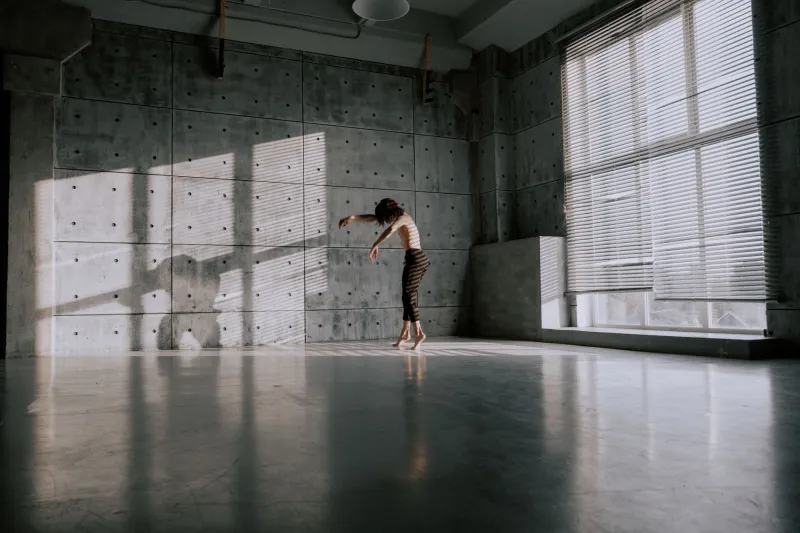
The first thing Claudia Merritt's students noticed was that she never looked at the speakers.
In any other dance studio, the instructor's relationship to the music is constant and visible — a head that tilts toward the beat, feet that find the downbeat before the correction comes, a body that's always, on some level, tracking the sound. Merritt didn't do any of that. She watched the dancers. She watched their weight shift, their breath, the microsecond of preparation before a movement began. She was reading something her students couldn't quite see, in a language they hadn't been taught.
She'd been Deaf since birth. She'd been dancing since she was four years old. By the time she was running her own company and teaching at a conservatory in the Pacific Northwest in the early 1990s, she had developed an approach to movement, rhythm, and physical training that the hearing dance world found simultaneously baffling and revelatory. It took about a decade for the field to catch up to what she was doing. When it did, the conversation about what dance actually was — and what it required — shifted in ways that are still playing out today.
Learning to Move in a Different Key
Merritt grew up in a small city in Oregon, the hearing child of Deaf parents — a family configuration that put her in an unusual position from the start. She moved fluidly between two linguistic worlds, and she grew up with an acute sensitivity to the non-verbal dimensions of communication that most hearing people learn to ignore.
Dance, for her, was never primarily about music. It was about bodies in space, about weight and tension and the physics of movement. She trained seriously through high school and into college, working in the modern dance tradition that had always been slightly more interested in movement as an independent language than ballet's more music-dependent structure. She lost the remainder of her residual hearing in her early twenties, a transition that she later described as clarifying rather than devastating.
"I stopped negotiating between what I heard and what I felt," she said in a 1997 interview with a dance journal. "I just felt. And what I felt was more information than I'd ever had access to before."
What she meant, specifically, was vibration. Not just the floor vibrations that many Deaf dancers describe using, but the full proprioceptive landscape of a body in motion — the internal rhythm of breath, heartbeat, muscle engagement, and momentum that exists entirely independently of any external sound source. She had always been aware of it. Now it was the only channel available, and she learned to read it with extraordinary precision.
The Notation Problem
Teaching what she knew turned out to be the harder challenge.
Existing dance notation systems — Laban notation being the most widely used in the American modern dance world — are primarily designed to capture the shape and sequence of movement, not its internal quality. They're good at recording what a body does and less good at recording how a body does it. For Merritt's approach, which was fundamentally about the experiential texture of movement rather than its external form, existing notation was nearly useless.
She spent several years in the early 1990s developing her own supplementary notation system, working in collaboration with a movement researcher at a university in Seattle. The system used a combination of graphic symbols and written descriptors to capture what she called "weight language" — the specific qualities of heaviness, lightness, suspension, and collapse that she was teaching her students to feel and produce. It wasn't a replacement for Laban. It was an additional layer, focused on the interior experience of a phrase rather than its exterior shape.
The notation work was painstaking and, initially, almost entirely unrecognized. She presented it at a small conference in 1993 and received polite but skeptical responses. The general consensus among the hearing dance professionals in the room was that what she was describing was interesting but probably not generalizable — that it worked for her because of her specific sensory profile, and that hearing dancers would always have a more direct relationship to musical rhythm than anything she could teach them.
That consensus turned out to be wrong.
What the Hearing Dancers Learned
The shift came gradually, through the dancers themselves.
Students who trained with Merritt consistently reported that working with her changed their relationship to music rather than removing it. By learning to feel rhythm from the inside — through breath, through weight transfer, through the physical logic of a phrase — they became more musical, not less. Their movement acquired a specificity and intentionality that their previous training, focused on matching external sound, hadn't produced.
Several of these students went on to teach themselves, and they brought Merritt's methods with them. By the early 2000s, her weight-language notation and her approach to internal rhythm had found their way into conservatory curricula in New York, Chicago, and Los Angeles — usually without her name attached, which is a separate and familiar story about whose contributions get credited in the arts.
The broader implication of her work — that hearing is not the primary channel through which rhythm is experienced in dance, but rather one channel among several — has since been supported by a significant body of movement science research. Studies on proprioception and motor timing have consistently found that internal physical cues are more reliable predictors of rhythmic accuracy than auditory cues alone. Merritt arrived at that conclusion through a lifetime of direct experience. The researchers confirmed it with instruments decades later.
The Margin as Method
What makes Merritt's story worth telling — beyond the individual achievement, which is considerable — is what it suggests about expertise and its origins.
The dance world had centuries of accumulated knowledge about how rhythm worked, how music and movement related to each other, what a trained dancer needed to develop. That knowledge was built entirely by and for hearing people, which meant it had a significant blind spot built in. It took someone approaching the field from outside that assumption to see what was missing.
This is a pattern that shows up across disciplines — the outsider who, precisely because they can't do things the established way, discovers that the established way wasn't the only way. Merritt didn't set out to revolutionize dance pedagogy. She set out to teach, using the tools she had. The revolution was a side effect of her refusal to accept that her experience of movement was less valid than anyone else's.
She still teaches. Her company still performs. The notation system she developed in a Seattle studio thirty years ago is still in use, still being refined, still opening up conversations about what bodies know that sound can't fully capture.
The music was never the whole story. She just happened to be the one who could prove it.